


[Lecture Report] 2025 Global Conference on Climate and Health (July 31, 2025, Brasília, Brazil)
date : 8/15/2025
Tags: Planetary Health

![[Lecture Report] 2025 Global Conference on Climate and Health (July 31, 2025, Brasília, Brazil)](https://hgpi.org/en/wp-content/uploads/sites/2/Eyecatch_GlobalConferenceonCliamateandHealth_20250731-scaled-1.jpg)
Adjunct Fellow Mr. Akira Shimabukuro and Associate Ms. Eri Cahill from Health and Global Policy Institute (HGPI) participated in the 2025 Global Conference on Climate and Health, held in Brasília, Brazil from July 29 to 31, 2025. On the final day, July 31, delivered a presentation on a supplementary document related to the draft of Belém Health Action Plan, which is expected to be adopted at the 30th Conference of the Parties (COP30) to the United Nations Framework Convention on Climate Change (UNFCCC).
This conference was co-hosted by the Government of Brazil, the World Health Organization (WHO), and the Pan American Health Organization (PAHO). It also served as the annual meeting of the Alliance for Transformative Action on Climate and Health (ATACH). Furthermore, this was the first official pre-COP event to place “health” at its core.
One of the primary objectives of the conference was to provide concrete recommendations for the draft of the Belém Health Action Plan, expected to be adopted at COP30 in Belém, Brazil in November 2025. The action plan aims to translate growing discussion on health at recent COPs into tangible actions. Since COP26 in Glasgow in 2021, the linkage between climate change and health has gained importance, supported by WHO’s special reports, the establishment of “Health Day” at COP28 in Dubai in 2023, and cross-sectoral collaboration promoted during COP29 in Baku, Azerbaijan in 2024. Health has thus emerged as a key driver for climate action.
A broad range of health risks, such as air pollution, heat waves, infectious disease outbreaks, food and water security, mental health, and the impact on vulnerable populations, has become the focus of discussion. Clean energy, sustainable food systems, health-conscious urban planning and infrastructure, and resilient health systems have been identified as pressing international issues. Since COP28, progress has also been made in creating health impact mitigation funds and financing health-related climate responses, reflecting a global movement toward a sustainable society that safeguards public health.
The draft Belém Health Action Plan focuses on two cross-cutting priorities; “Health equity and climate justice” and “leadership and governance on climate and health through social participation.” It is structured around three main pillars of action:
- Health surveillance and monitoring
- Evidence-based policy strategies and capacity building
- Innovation and production
HGPI contributed a supplementary document to the “Innovation and Production” workshop, based on its December 2024 column titled “Vol. 11: Toward Achieving Carbon Neutrality in Japan’s Pharmaceutical Industry”. Mr. Shimabukuro presented the following key points:
- Building partnerships between the healthcare sector (e.g., the pharmaceutical industry) and the government can accelerate innovation and the adoption of technologies, reinforcing leadership and governance.
- Leadership by healthcare professionals is essential for transitioning to sustainable, environmentally responsible health systems, and capacity building is critical to support this leadership.
- Adaptation of healthcare supply chains requires coordinated efforts across the health system to implement both mitigation and adaptation strategies concurrently.
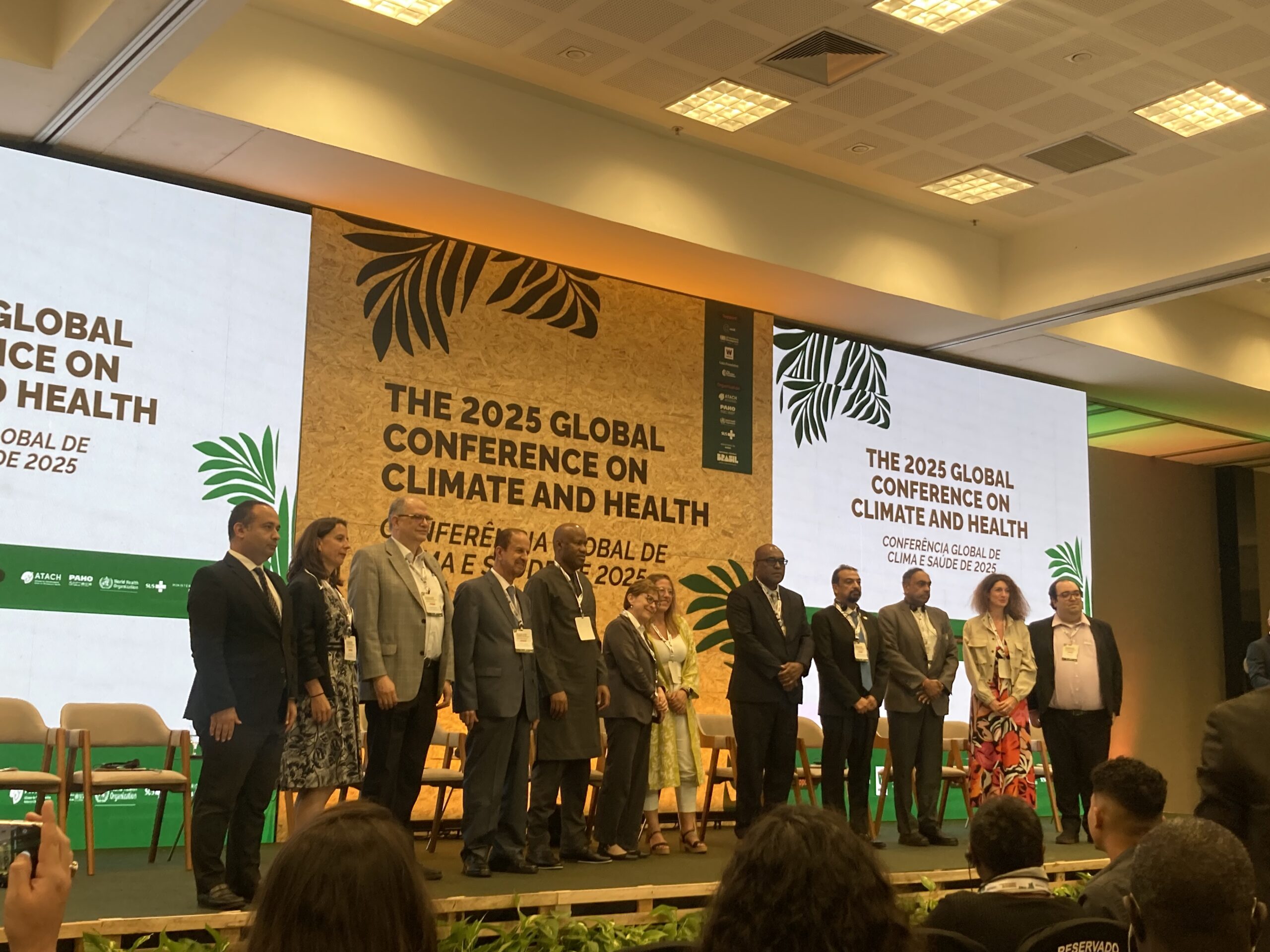 During the working group sessions, the staffs of HGPI also participated in in-depth discussions to provide direct feedback on the draft of the Belém Health Action Plan, contributing to the identification of challenges and potential solutions from multiple perspectives. Participants included representatives from ministries of health, researchers, international organizations, and civil society groups.
Japan’s Ministry of Health, Labour and Welfare also presented a case study on disaster relief medical response as part of Japan’s adaptation strategies to climate change. Japan joined the ATACH framework in 2024, with HGPI also participating as a non-state actor member from the same year.
Looking ahead, as the Belém Health Action Plan moves toward official adoption at COP30, the second in-person meeting of the Baku Coalition will be held during the UN General Assembly in September. This meeting will aim to deepen discussions and build international consensus in cooperation with UNFCCC parties and related organizations.
Additionally, following the precedent set at COP28, “Health Day” at COP30 is scheduled for Thursday, November 13, 2025. HGPI will continue contributing to global efforts to address climate and health challenges through policy recommendations and international collaboration.
Related Posts
-
2025-06-09
[Policy Recommendation] Integrating “Planetary Health” as a Growth Strategy — Proposal for the Grand Design and Action Plan for a New Form of Capitalism (2025 Revised Edition) (June 9, 2025)
-
2024-06-26
[Policy Recommendations] Developing a National Health and Climate Strategy for Japan (June 26, 2024)
-
2024-06-05
[Announcement] A Turning Point Towards Building Green Healthcare Systems (June 5, 2024)
-
2024-04-25
[Announcement] HGPI Joins Alliance for Transformative Action on Climate and Health (April 22, 2024)
-
2025-07-02
[HGPI Policy Column] (No.61) — From the Planetary Health Project “Part 15: WHO's Response to the Climate and Health Crisis: The Global Action Plan on Climate Change and Health”
-
2024-12-12
[HGPI Policy Column] (No. 51) From the Planetary Health Project “Part 11: Efforts Toward Achieving Carbon Neutrality in Japan's Pharmaceutical Industry”
Top Research & Recommendations Posts
- [Research Report] Perceptions, Knowledge, Actions and Perspectives of Healthcare Organizations in Japan in Relation to Climate Change and Health: A Cross-Sectional Study (November 13, 2025)
- [Research Report] The 2025 Public Opinion Survey on Healthcare in Japan (March 17, 2025)
- [Policy Recommendations] Developing a National Health and Climate Strategy for Japan (June 26, 2024)
- [Research Report] The 2023 Public Opinion Survey on Satisfaction in Healthcare in Japan and Healthcare Applications of Generative AI (January 11, 2024)
- [Research Report] Survey of Japanese Nursing Professionals Regarding Climate Change and Health (Final Version) (November 14, 2024)
- [Policy Recommendations] Mental Health Project: Recommendations on Three Issues in the Area of Mental Health (July 4, 2025)
- [Policy Recommendations] Reshaping Japan’s Immunization Policy for Life Course Coverage and Vaccine Equity: Challenges and Prospects for an Era of Prevention and Health Promotion (April 25, 2025)
- [Publication Report] Planetary Health Promotion Project “Issues Facing Planetary Health and the Role of the Health Sector” (May 10, 2023)
- [Research Report] Survey of Japanese Physicians Regarding Climate Change and Health (December 3, 2023)
- [Announcement] HGPI Joins Global Green and Healthy Hospitals (August 1, 2023)
Featured Posts
-
2025-11-13
[Registration Open] (Webinar) The 1st J-PEP Seminar – Initiating Policy Advocacy from Meaningful Involvement (December 8, 2025)
![[Registration Open] (Webinar) The 1st J-PEP Seminar – Initiating Policy Advocacy from Meaningful Involvement (December 8, 2025)](https://hgpi.org/en/wp-content/uploads/sites/2/mip-ncd-20251208-top.png)
-
2025-12-01
[Policy Recommendations] Recommendations on Strategic Investments in Policies for Brain Health to Revitalize Japan: Hopes for the New Administration (December 1, 2025)
![[Policy Recommendations] Recommendations on Strategic Investments in Policies for Brain Health to Revitalize Japan: Hopes for the New Administration (December 1, 2025)](https://hgpi.org/en/wp-content/uploads/sites/2/HGPI_20251201_Recommendations-on-Strategic-Investments-in-Policies-for-Brain-Health.png)
